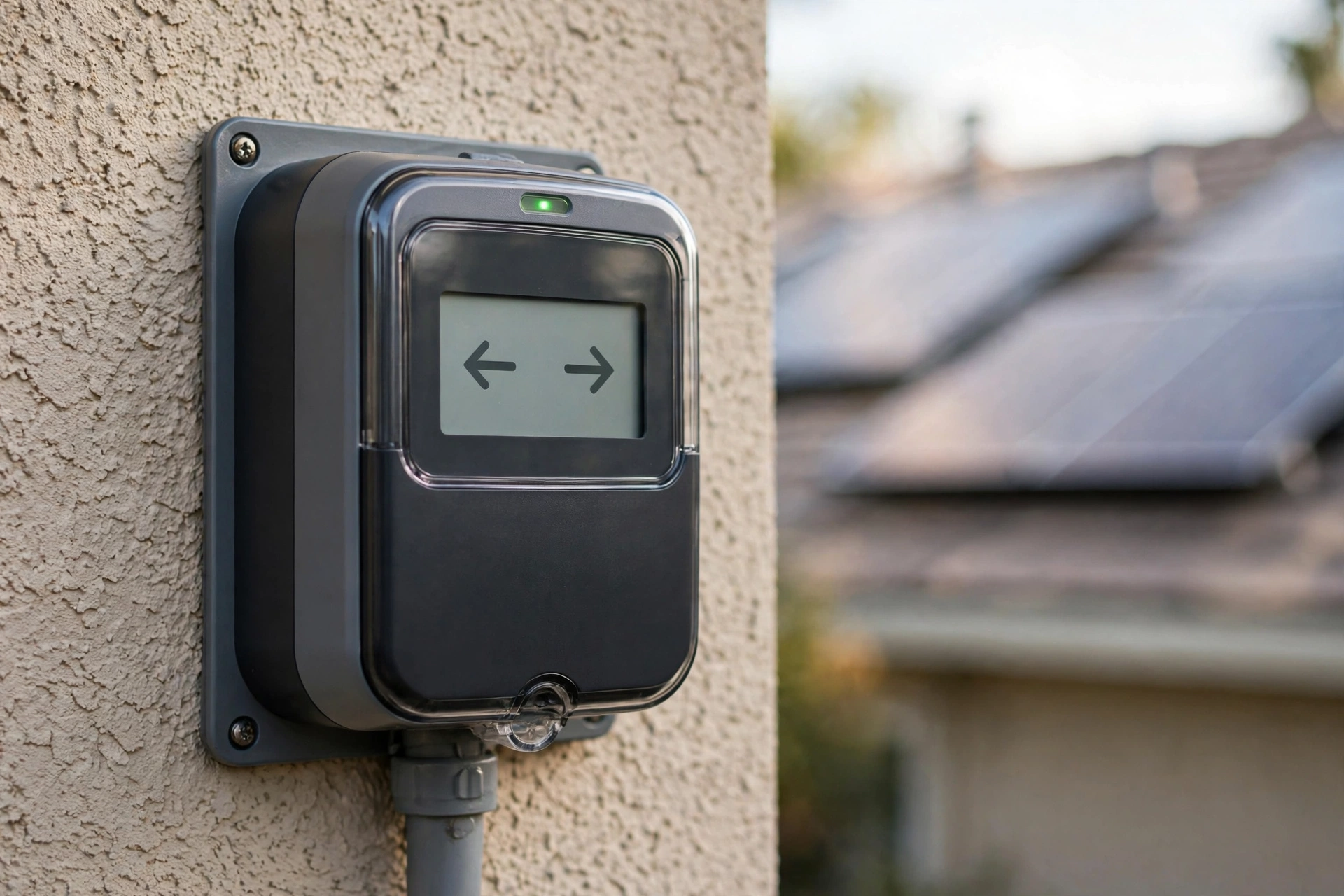
Net metering credits the excess solar electricity you send to the grid at the full retail rate, while net billing pays you a lower, wholesale-style rate for that same electricity. The difference can change your solar savings by thousands of dollars over a system's life — which is why knowing which policy your utility uses is one of the most important things to learn before you buy.
The short version: net metering is better for homeowners, and it is slowly being replaced by net billing across the country. About 34 states plus Washington, DC still require net metering, but states like California have already switched to net billing, and more utilities are pushing in that direction. Below is what each system means in plain English, how they compare, where each one applies, and what to do about it.
What is net metering?
Net metering is a billing arrangement that lets your electricity meter effectively run backward. When your panels produce more electricity than your home is using — typically on sunny middays — the surplus flows to the grid and your utility gives you credits at the full retail rate, the same rate you pay when you buy electricity. At night, you draw from the grid and use those credits to offset what you owe.
The result is that the grid acts like a free battery: you "store" daytime surplus as bill credits and "withdraw" it in the evening at no penalty. Under true retail-rate net metering, every kilowatt-hour your system produces is worth exactly what a kilowatt-hour from the grid costs you, regardless of when you produced it. This is why solar economics have historically been strongest in net metering states — timing does not matter, and storage is optional. For the full breakdown of how the crediting works, see our net metering explainer.
What is net billing?
Net billing looks similar on the surface but works very differently underneath. Your surplus electricity is still sent to the grid, but instead of earning credits at the full retail rate, it is credited at a lower rate — often called the "avoided cost" rate, which reflects what the utility would have paid to generate or buy that power itself.
The gap can be large. In California under NEM 3.0, exported solar earns roughly 5 to 8 cents per kWh on average (10 to 20 cents during peak summer evenings), while the homeowner pays 30 cents or more to import electricity. That means timing suddenly matters a great deal: a kilowatt-hour you use yourself is worth three to six times a kilowatt-hour you export. Net billing rewards self-consumption — and that is exactly why batteries have become so popular in net billing states. Our battery guide walks through when storage makes financial sense under these rules.
How do net metering and net billing compare?
Here is the side-by-side view:
| Net metering | Net billing | |
|---|---|---|
| Credit for exported solar | Full retail rate | Lower avoided-cost rate |
| Value of self-consumed solar | Same as exported (timing irrelevant) | Worth much more than exported (timing critical) |
| Typical bill impact | Bills near zero possible with a right-sized system | Near-zero bills are hard; some grid imports are unavoidable |
| Battery need | Optional — the grid acts as your "battery" | Strongly recommended to shift power into evening hours |
| Typical solar-only payback | Shorter (6–9 years in high-rate states) | Longer (9–14 years in California under NEM 3.0) |
| Where it applies | ~34 states + DC | CA, NV, AZ, HI, SC, IN and growing |
Neither system is a scam — net billing simply reflects the utility industry's argument that grid-maintained infrastructure has costs beyond the raw electricity. But from the homeowner's perspective, the takeaway is unambiguous: net metering pays you more for the same panels, and the difference directly affects how quickly your system pays for itself.
Which states have net metering, and which have net billing?
The national picture in 2026 breaks into four groups. Utility rules can vary within a state, so always confirm your specific utility's policy — but this is the overall landscape:
| Policy type | Where it applies |
|---|---|
| Retail-rate net metering (mandatory in ~34 states + DC) | MA, NJ, NY, MD, CT, IL, MN, OR, CO, and others |
| Net billing | CA (NEM 3.0), NV, AZ, HI, SC, IN |
| Avoided-cost only (low export compensation) | AL, TN, KY, parts of TX, ID |
| No statewide net metering policy | TX — rules are set utility by utility |
The trend is worth watching: utilities in several net metering states have proposed moving to net billing, and grandfathering clauses matter enormously. If your state still has net metering, installing sooner rather than later can lock in the better rules for years. Our state-by-state solar guides track the current policy in each state so you can check where yours stands.
What changed under California's NEM 3.0?
California's NEM 3.0 — officially the Net Billing Tariff, in effect since April 2023 — is the most important case study in American solar policy because California is the country's largest residential solar market. The change replaced retail-rate net metering with net billing based on avoided-cost rates.
The numbers tell the story. Under NEM 3.0, exported solar earns roughly 5 to 8 cents per kWh on average, rising to 10 to 20 cents during peak summer evening hours when the grid is stressed. Against import rates of 30 cents or more, self-consumption went from a nice-to-have to the entire strategy. The practical effects:
- Solar-only payback stretched to roughly 9 to 14 years for new California systems.
- Solar-plus-storage payback improved to roughly 8 to 12 years, because batteries let homeowners use their own power during expensive evening hours instead of exporting it for pennies.
- Battery attachment rates soared — most new California residential systems now include storage, a complete reversal from the net metering era.
- Existing NEM 2.0 customers were grandfathered for 20 years, which is why acting before a policy change matters so much.
Other states are watching California closely. If your utility is lobbying for similar changes, assume net billing is coming and design your system — and your battery decision — accordingly. You can model both scenarios with our California savings calculator.
How do batteries change the math under net billing?
Under net metering, a battery is a luxury: the grid already stores your surplus for free. Under net billing, a battery is the tool that rescues your economics. By storing midday surplus and discharging it during expensive evening hours, a battery converts power that would have earned 5 to 8 cents into power that offsets 30-cent imports — a three-to-six-times value multiplier on every stored kilowatt-hour.
The benchmark home battery is the Tesla Powerwall 3: 13.5 kWh of usable storage, 11.5 kW of continuous power output, LFP (lithium iron phosphate) chemistry, and a 10-year warranty covering 70 percent capacity retention. A typical installed cost is $13,000 to $16,500 per unit — EnergySage reports about $15,650 for a 13.5 kWh installation. Note that there is no federal residential credit for battery installs in 2026, so the full cost sits on the homeowner.
The rule of thumb: if your utility uses net billing or avoided-cost rates and your evening electricity is expensive, a battery usually pays for itself within the system payback window. If you have full retail net metering, spend the battery money on a slightly larger solar array instead — the grid is already doing the battery's job for free. Our solar guides hub has deeper reading on system design for both scenarios.
How do you find your utility's exact policy?
State-level summaries are a starting point, but the policy that governs your bill is your utility's specific tariff. Here is how to pin it down:
- Check DSIRE. The Database of State Incentives for Renewables and Efficiency (run by North Carolina State University) catalogs net metering and interconnection policies by state and utility — it is the authoritative reference.
- Read your utility's solar or "distributed generation" page. Search your utility's site for "net metering," "net billing," or "solar buyback." Look for the export credit rate in cents per kWh and any monthly minimum charges.
- Ask your installer in writing. A good local installer knows the current tariff cold — but get the export rate and any grandfathering terms in the proposal, not just verbally.
- Check your own bill. Once installed, your bill should show export credits or payments as a line item. If the numbers do not match what you were promised, call the utility before the next billing cycle.
Frequently asked questions
Is net metering better than net billing for homeowners?
Yes. Net metering credits your exported solar at the full retail rate, while net billing pays a lower avoided-cost rate. The same system earns noticeably more under net metering, which is why solar payback periods are shorter in net metering states.
Does California still have net metering?
No — not for new systems. California switched to net billing (NEM 3.0) in April 2023. Customers on the old NEM 2.0 tariff are grandfathered for 20 years, but new installations fall under the lower avoided-cost export rates.
Do I need a battery if my state has net metering?
Not for financial reasons — the grid effectively acts as a free battery under retail-rate net metering. Batteries in net metering states are mainly about backup power during outages, not savings.
Can my utility change from net metering to net billing after I install?
Utilities can and do change tariffs, which is why grandfathering clauses matter. Most policy changes grandfather existing customers for a set period (California's NEM 2.0 customers got 20 years). Always check the grandfathering terms before you sign.
What is the avoided cost rate?
It is the rate utilities pay for exported solar under net billing — roughly what it would cost them to generate or buy that electricity themselves. It is typically far below the retail rate you pay for imports, often 5 to 8 cents per kWh.