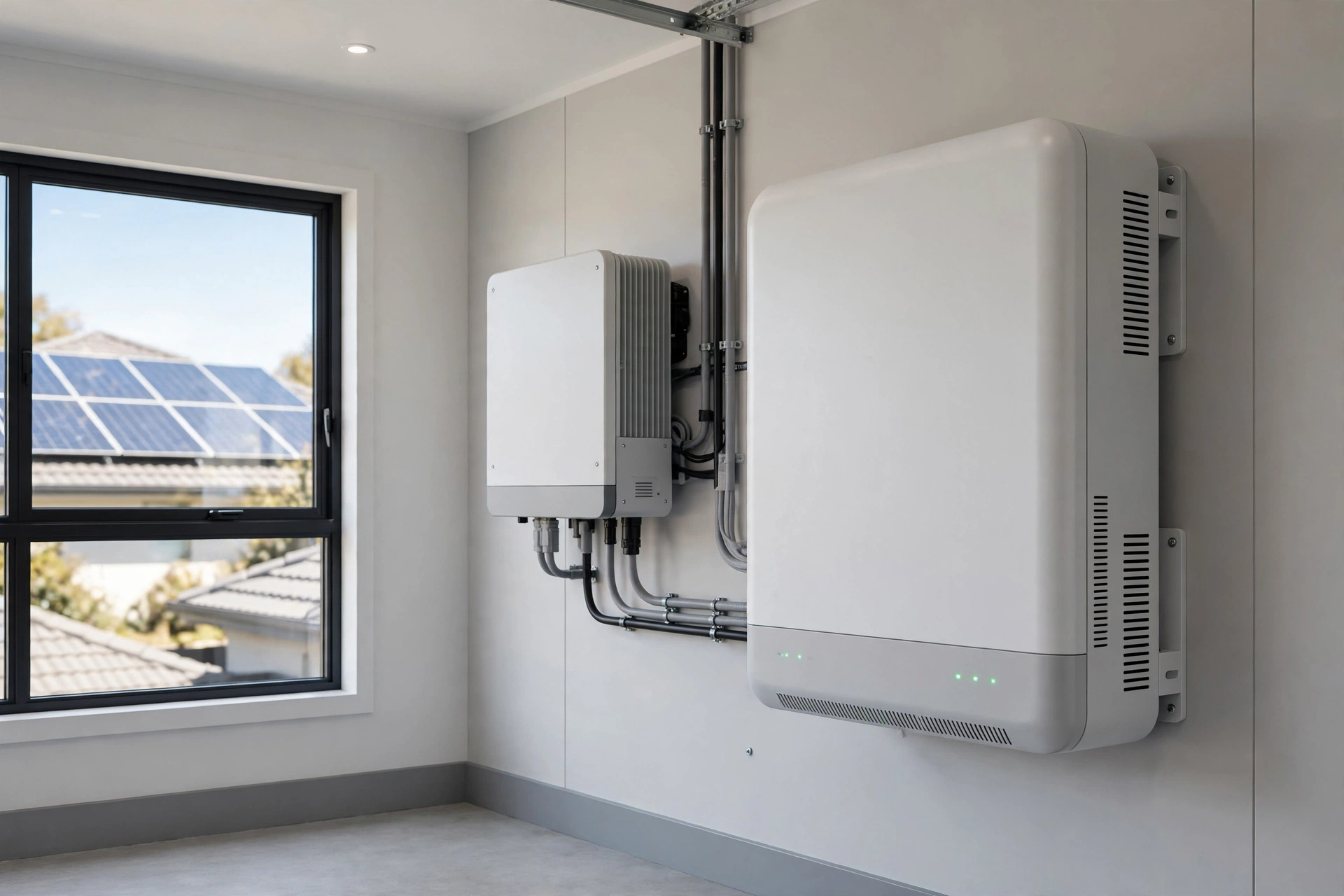
Most homes need 10 to 15 kWh of battery storage for critical overnight loads, or 25 to 40 kWh for whole-home backup. A 13.5 kWh unit like the Tesla Powerwall 3 covers lights, refrigeration, Wi-Fi, and charging for most families. Size storage to your daily use and outage goals, not to your solar array's wattage.
What is the difference between kWh and kW in a battery?
This is the single most important concept in battery sizing. kWh (kilowatt-hours) measures energy — how much electricity the battery stores. kW (kilowatts) measures power — how fast it can deliver that electricity.
Think of it as a water tank: kWh is the size of the tank, kW is the width of the pipe. A big tank with a narrow pipe can run small loads for a long time but cannot start your air conditioner. A battery needs both numbers to match your needs.
The Tesla Powerwall 3, the most common home battery in 2026, stores 13.5 kWh of usable energy and can deliver 11.5 kW of continuous power. That combination handles a night of essential loads for most homes and can start many air conditioners — but a whole-home backup during a heat wave may need two units. Always compare both figures when shopping, because a battery with plenty of kWh but modest kW can leave you in the dark the moment a big appliance kicks on.
How do you size a home battery?
Follow four steps, in this order:
- Find your daily usage. Divide a recent monthly bill by 30. The average US home lands near 29 kWh per day, but your number is what matters.
- Choose your backup goal. Critical loads (fridge, lights, Wi-Fi, phone charging, medical devices) usually need 8–15 kWh per day. Whole-home backup needs your full daily usage.
- Pick your days of autonomy. Most grid-connected homes size for one night — enough to ride through an outage until solar recharges the battery in the morning. True multi-day autonomy is an off-grid goal and gets expensive fast.
- Check continuous power. Add up the running watts of everything you want on at once, and confirm the battery's kW rating covers the largest motor start (air conditioners and well pumps surge at startup).
The core formula: daily kWh × days of autonomy = usable storage needed, since modern lithium batteries allow nearly 100% depth of discharge. One night of critical loads at 10 kWh needs roughly one Powerwall 3; whole-home backup at 29 kWh per day needs two to three units. If you are still deciding on the panels side, start with our guide to how many solar panels you need, since battery and array sizing go hand in hand.
Should you back up critical loads or your whole home?
Most buyers choose critical-load backup, and the economics explain why:
| Backup strategy | Typical storage | What it covers | Relative cost |
|---|---|---|---|
| Critical loads | 10–15 kWh | Fridge, lights, Wi-Fi, phones, medical devices, some outlets | One battery unit |
| Partial home | 15–25 kWh | Above plus TV, microwave, small AC or fan | One to two units |
| Whole home | 25–40 kWh | Everything, including central AC and electric cooking | Two to three units |
Choose critical loads if outages in your area are short, your budget is tight, or you mainly want to keep food cold and stay connected. Choose whole home if you have medical equipment that cannot lose power, work from home during storm season, or live where outages last days. Middle path: back up critical loads now and wire the panel for a second battery later.
How many kWh does a Powerwall 3 hold — and is one enough?
The Powerwall 3 holds 13.5 kWh of usable energy and delivers 11.5 kW of continuous power. It uses LFP (lithium iron phosphate) chemistry rated for 6,000+ cycles, ships with a built-in solar inverter, and carries a 10-year warranty guaranteeing at least 70% capacity retention, with unlimited cycling within the warranty.
For most families, one unit covers a full night of critical loads: a modern fridge uses about 1–2 kWh overnight, LED lighting a fraction of a kWh, Wi-Fi and phone charging well under 1 kWh. Where one unit falls short is heavy simultaneous loads — running central air conditioning all night alongside everything else can drain 13.5 kWh before morning.
Alternatives exist in modular designs that let you stack capacity in smaller increments, which suits partial-home backup. When comparing any battery, weigh four things side by side: usable capacity (not nameplate), continuous power, chemistry and cycle life, and warranty terms. A detailed walkthrough of the Powerwall 3's specs is available at Tesla's official Powerwall specs, and our home battery buyer's guide compares the broader market.
What does a solar battery cost in 2026?
A single 13.5 kWh battery typically costs $13,000–$16,500 installed in 2026. EnergySage reported a typical installed price of about $15,650 for a 13.5 kWh battery in July 2026. That figure covers the unit, inverter, installation labor, permits, and basic electrical work.
Costs climb with complexity. Whole-home backup with two or three units can run $25,000–$45,000 installed, especially if your main electrical panel needs an upgrade. Retrofitting a battery onto existing solar usually adds labor compared with installing both together, since the crew must integrate with a live system. Get at least three quotes, and compare them on installed $/kWh of usable storage — the fairest apples-to-apples metric. For the panels side of the budget, see what residential solar costs in 2026.
When do batteries pay off financially — and when are they purely for resilience?
Batteries pay for themselves fastest in three situations:
- Net billing instead of net metering. Under rules like California's NEM 3.0, exporting solar earns only about 5–8¢/kWh on average (10–20¢ during peak hours) instead of full retail credit. Storing that energy and using it yourself is worth far more than exporting it. See net metering vs. net billing for the full comparison.
- Time-of-use rates. Charge the battery from midday solar, discharge during the expensive evening peak — the daily price spread becomes your savings.
- Demand charges or frequent outages. Some utilities bill commercial-style demand charges; others simply fail often enough that backup has real economic value (spoiled food, lost work hours, hotel stays).
A battery bought purely for resilience — keeping medical devices running, staying powered through multi-day storms — may never "pay back" in bill savings, and that is fine. Just buy it with open eyes: resilience is the product, not the savings. Be skeptical of any quote promising a 5-year payback without showing the utility-rate math behind it.
Should you choose AC-coupled or DC-coupled storage?
The two wiring approaches suit different situations:
- AC-coupled batteries (including the Powerwall and Enphase systems) connect on the AC side of your electrical panel. They retrofit easily onto existing solar, work with almost any inverter, and simplify adding storage years after the panels. Slight conversion losses occur as power changes form twice.
- DC-coupled batteries connect directly to the DC side and need a compatible hybrid inverter. They are marginally more efficient at storing solar energy, but they usually require the inverter to be chosen with storage in mind from day one.
Rule of thumb: adding a battery to existing solar — go AC-coupled. Installing solar and storage together — compare both, and let your installer's equipment preferences and your utility's interconnection rules decide. Either way, confirm the battery and inverter are on the same compatibility list before signing.
How long do solar batteries last?
Modern LFP home batteries are rated for 6,000+ charge cycles, which typically translates to 15–20 years of service in a home that cycles roughly once a day. The standard warranty is 10 years with at least 70% capacity retention — meaning the manufacturer guarantees the battery still holds 70% of its original capacity at year 10.
Batteries fade; they rarely die suddenly. A 13.5 kWh unit at 80% health still stores nearly 11 kWh — enough for critical loads for years beyond the warranty. Heat shortens battery life, so shaded or garage installations age better than units baking in direct sun.
Are there any incentives left for batteries in 2026?
The headline change: the 30% federal residential solar tax credit (Section 25D) ended for homeowner-owned systems installed after December 31, 2025 — so batteries installed in 2026 get a 0% federal residential credit. Do not let a salesperson tell you otherwise.
What remains: batteries paired with leased solar or a power purchase agreement can still carry federal value through Section 48E, generally through December 31, 2027, because the credit flows to the system owner. Some states and utilities also offer their own battery rebates or demand-response programs that pay you for letting the utility draw on your battery during grid stress. Check the DSIRE database for programs in your state, and review the current federal solar tax credit status so you know exactly where things stand.
Frequently asked questions
How many kWh battery do I need for my house?
For critical-load backup through the night, 10–15 kWh of usable storage suits most homes. For whole-home backup, plan on 25–40 kWh. Start from your daily kWh usage and your outage goals, not from your solar array's size.
Is one Tesla Powerwall enough for a house?
One 13.5 kWh Powerwall 3 covers a night of critical loads — fridge, lights, Wi-Fi, charging — for most families. It is usually not enough for whole-home backup with central air conditioning running all night; that typically needs two units.
How long will a 13.5 kWh battery last during an outage?
Running only critical loads (roughly 8–12 kWh per day), one 13.5 kWh battery lasts through the night with margin. Running a full home at 29 kWh per day, it lasts about half a day. Paired with solar, it recharges each morning and can carry critical loads through multi-day outages.
Can I add a battery to my existing solar panels?
Yes. AC-coupled batteries retrofit onto almost any existing system without replacing your inverter. Your installer will check panel capacity, wiring, and permitting, but most retrofits are straightforward one- to two-day jobs.
Do solar batteries work during a power outage?
Yes, if the system is designed for it. Standard grid-tied solar shuts down in an outage for safety, but a battery with islanding capability keeps your backed-up circuits running. Confirm "whole-home" or "critical-load" backup is in your contract — not just storage.
What is the lifespan of a home solar battery?
LFP batteries are rated for 6,000+ cycles — typically 15–20 years of daily use. Most carry a 10-year warranty guaranteeing at least 70% capacity retention. Capacity fades gradually rather than failing outright.